Application Notes
Wavefront Sensor for High Speed Adaptive Optics based Astronomy
Author: Dr Andrew Dennis
Published: 01 Nov 2018 · Last updated: 26 Jan 2024
Tags: wavefront-sensors-app
As previously mentioned in Introduction to Astronomical Adaptive Optics, the Adaptive optic approach is a powerful tool for minimising the distortions caused by Atmospheric turbulence.
The Shack-Hartmann based Wavefront sensor approach can be seen at The Center for High Angular Resolution Astronomy (CHARA) Array, [2, 3] at the Mount Wilson Observatory. See Figure 1 & 2. The Chara Array is a IR and Near Infrared telescope system comprising of 6 optically connected telescopes, each fitted with an EMCCD (Andor iXon Ultra) based AO system which operates at 1000 frames per second (set up using a 90 x 90 pixel ROI).

Figure 1. Shack Hartmann Adaptive Optic setup at the Chara Array [4]
And alternative AO implementations can be found at The Large Binocular Telescope which utilises a Laser based guide Star, adaptive secondary mirror with 672 actuators and Andor Zyla sCMOS camera operating at 1 kHz (200 x 200 Pixels). [5,6]
The Raven AO system utilises 5 EMCCD cameras and used multiple objects in a field of view to perform Multi-object correction over a very large image plane.[8,9]
Table 1 Shows a broad range of Adaptive Optic systems and the telescopes where they are based.
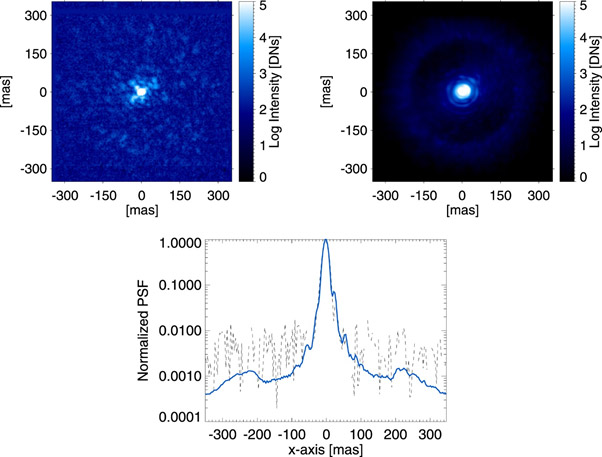
Figure 2. Top left: short exposure (1 ms) PSF of GLIESE 777. Top right: long exposure (5 s) PSF of GLIESE 777. Bottom: radial profile of both short (dashed line) and long (blue continuous line) exposure PSFs. [7]
| Table 1, A list of Innovative Adaptive Optic systems. | |||
| 1 | Chara Array | Mt Wilson Observatory, CA | iXon 897 EMCCD |
| 2 | Large Binocular Telescope | Mt Graham International Observatory, AZ | Zyla sCMOS |
| 3 | Multi-Object Adaptive Optics (MOAO) | Subaru Telescope, Hawaii | 5 x Zyla |
| 4 | The portable adaptive optics System | Various | iXon 897 EMCCD |
| 5 | The Subaru Coronagraphic Extreme Adaptive Optics (SCExAO) instrument - VAMPIRES | Subaru Telescope, Hawaii | iXon 897 EMCCD |
| 6 | Robo AO | Palomar Observatory, CA | iXon 888 EMCCD |
| 7 | Fastcam | William Herschel Telescope, Canary Islands, Spain | iXon 897 EMCCD |
| 8 | Anglo Australian Telescope AO | Siding Spring Observatory, Australia | Zyla sCMOS |
| 9 | Canary Moao | William Herschel Telescope, Canary Islands, Spain | iXon EMCCD |
- 12 October 2009 / Vol. 17, No. 21 / OPTICS EXPRESS 18970
- T. A. ten Brummelaar, H. A. McAlister, S. T. Ridgway, W. G. Bagnuolo Jr., N. H. Turner, L. Sturmann, J. Sturmann, First results from the CHARA Array. II. A description of the instrument, Astrophys. J. 628, p. 453-465, 2005
- T. A. ten Brummelaar, H. A. McAlister, S. Ridgway, D. R. Gies, J. Sturmann, L. Sturmann, N. H. Turner, An update on the CHARA Array, Proc. SPIE 7013, p. 701308, 2008. doi:10.1117/12.788008
- http://www.physics.usyd.edu.au/~bnorris/QAstro2015_Talks/2015_08_Quantum_Talk_Theo.pdf
- F. Pedichini et al 2017 Astronomical Journal 154 74
- Astronomical Adaptive Optics Systems and Applications IV. Edited by Tyson, Robert K.; Hart, Michael. Proceedings of the SPIE, Volume 8149, pp. 814902-814902-10 (2011)
- http://iopscience.iop.org/article/10.3847/1538-3881/aa7ff3/meta
- http://web.uvic.ca/~ravenmoa/Docs/Andersen_AO4ELT2_2012.pdf
- http://web.uvic.ca/~ravenmoa/