Aim
Research reveals that the addition of rare earth elements (REEs), such as La and Ce, can improve the mechanical properties of steels by modifying inclusions within them. Therefore, an understanding of these rare earth element inclusions is essential if the approach is to be used to improve the processing and performance of steels. Measurement of the properties (size distribution, abundance and composition) of inclusions related to the REEs is therefore of great importance.
Challenge
REEs are heavier than Fe, and often coexist alongside the more usual non-metallic inclusions containing light elements such as Al, Mn, Mg, Si and S – thereby forming complex inclusions. When this happens, the inclusion, as always, needs to be treated as a single feature even though it is made up of multiple parts. This is a challenge for automated analysis as the different parts of these complex inclusions have very different contrast in the back scattered electron (BSE) image and as such cannot be detected as single inclusions by traditional means. This has the potential to result in errors in the measurement of both morphology and composition, and thus could cause a miscalculation of the effect of REEs on the steel. An example of the appearance of a REE-containing inclusion in a BSE image is shown in Figure 1.
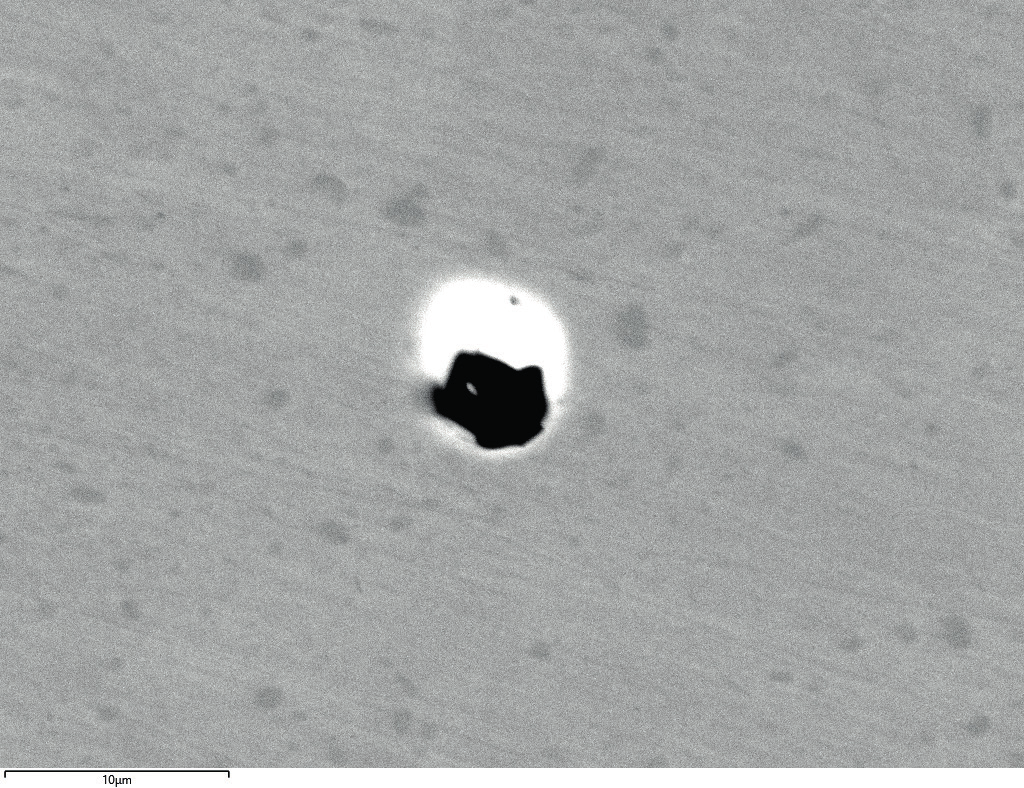
Figure 1. BSE image of a complex inclusion.
Solution
In the latest version of AZtecSteel – the non-metallic inclusion analysis package for the AZtecFeature particle analysis platform, it is possible to detect an inclusion that contains multiple phases including those that are both lighter and darker than the matrix as a single inclusion. In order to do this, a new functionality has been implemented that allows the part of the grey level range that should not be thresholded to be chosen and inverted – so that the rest is thresholded (Figure 2a). Morphology and composition can then be correctly measured as a whole (Figure 2b & 2c).
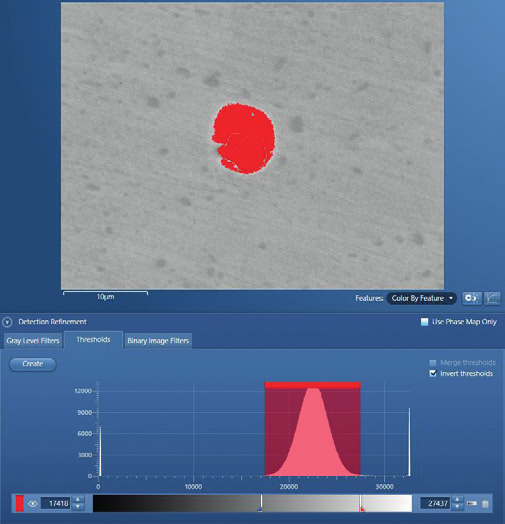
Figure 2a
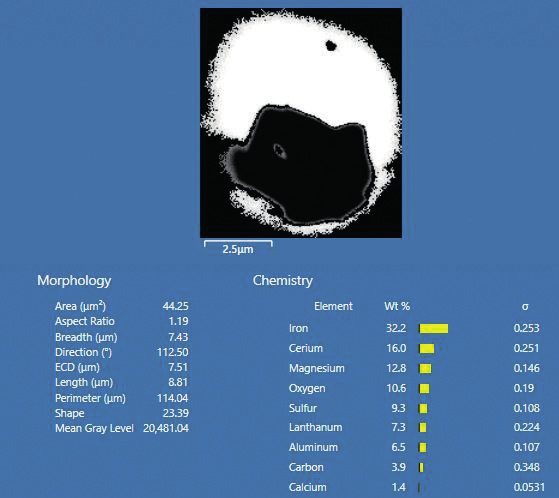
Figure 2b
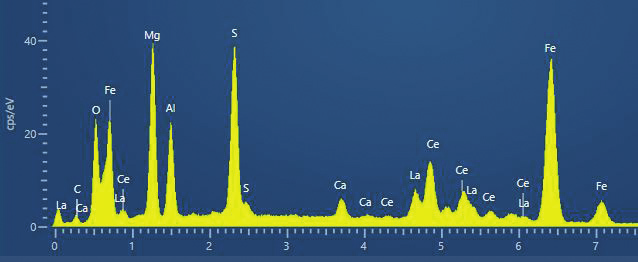
Figure 2c
Figure 2 (a) Complex inclusion is detected as whole (b) Morphology and composition of the complex inclusion are measured correctly as a single inclusion; (c) EDS sum spectrum from the complex inclusion.
Conclusion
In AZtecSteel, it is possible to automatically detect and measure complex inclusions in REE treated steels for correct morphological and compositional analysis of inclusion content.