Introduction
In the past, characterising non-metallic inclusions and precipitates in steels and other alloys, especially for light elements such as boron, has presented a challenge. However, AZtecFeature, in combination with a high solid angle windowless EDS detector such as X-Max Extreme and a conventional large area detector, provides exciting, novel capabilities.
Impurity and alloying elements are present in virtually all metals and alloys employed for structural use. They may be added intentionally to enhance desirable properties or be present as contaminants and detrimental to materials properties. If the average content of an impurity exceeds its solubility in the matrix it will often form precipitates or inclusions, often by combining with other impurities or with one of the main constituents. AZtecSteel and AZtecFeature detect and analyse inclusions and precipitates automatically over large areas. Based on the composition measured from the EDS spectrum and the morphology determined from the electron image, each inclusion can be automatically categorised or 'classified'.
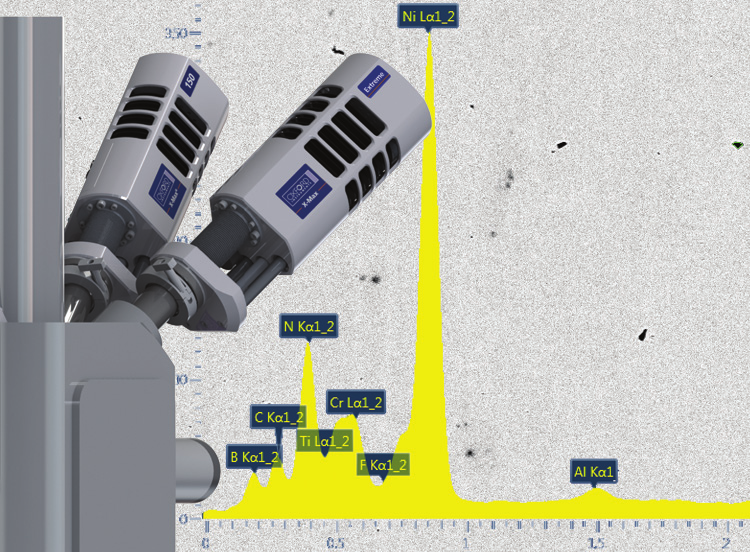
In order to obtain statistically relevant data, large numbers of inclusions are usually analysed and EDS acquisition time per inclusion is kept well below one second. This usually means that minor elements or light elements such as boron and nitrogen are not detected during particle analysis runs with conventional EDS detectors. Here we show results from nitride and boride inclusions found during an AZtecFeature run in a nickel-chromium alloy and in an aluminium sample using an X-Max Extreme and X-MaxN 150 detector operating in parallel. X-Max Extreme is a new, high sensitivity and high solid angle, windowless detector and X-MaxN 150 is a large solid angle conventional detector. With the combination of a windowless and a traditional windowed, large solid angle detector it is possible to:
- Rapidly find and identify all types of non-metallic inclusion
- Reliably detect and classify borides, nitrides and other inclusions containing light elements at a rate of >100 inclusions per minute
- Analyse samples at high acceleration voltage (X-MaxN only) and low kV (X-MaxN and X-Max Extreme combined)
- Acquire X-ray maps at high spatial resolutions <10 nm (SEM dependent)
Results
Figure 1 shows images and spectra of titanium nitride and boron nitride type inclusions found in a nickel-chromium alloy during an automated particle analysis run. Both boron and nitrogen are clearly visible and identified during the run.
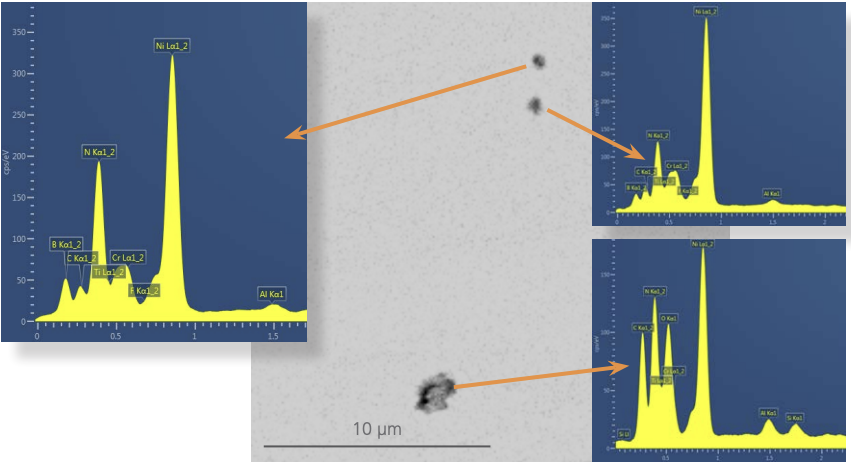
Fig. 1. Shows images and spectra of titanium nitride and boron nitride type inclusions found in a nickel-chromium alloy during an automated particle analysis run. Both boron and nitrogen are clearly visible and identified during the run.
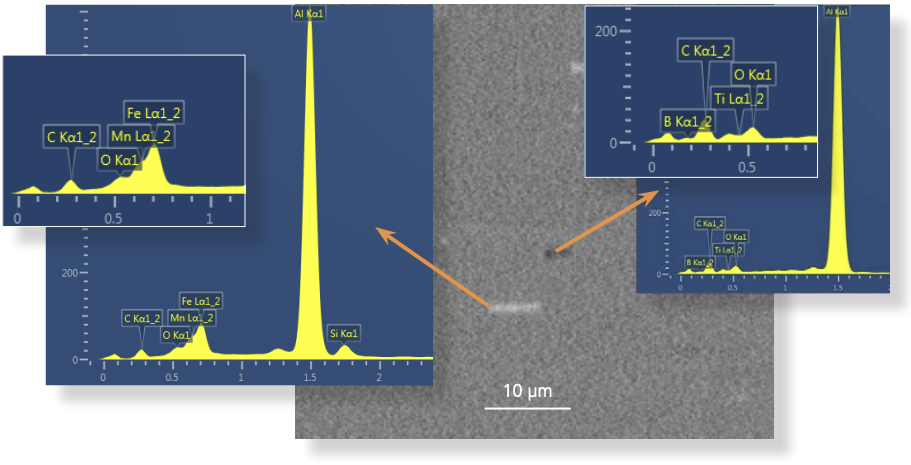
Fig. 2. Shows titanium-boronaluminium inclusion that were picked up in aluminium. Ti-B-Al particles are commonly added to aluminium as grain refiners to create a more homogeneous microstructure and therefore improve the machinability of aluminium.
Conclusion
As the X-Max Extreme and X-Max detectors can be used individually or simultaneously, the system combines the flexibility of a more conventional setup with the ability to detect light elements and minor constituents during automated particle analysis runs and, if the SEM allows, the acquisition of very high resolution EDS maps.