Fast, Reliable Failure Analysis—Even with Large Unprepared Samples
In industries where safety and performance are paramount, such as aerospace, automotive, and defense, understanding material behavior under tensile loading is critical. Tensile strength testing provides insights into material integrity and performance, helping engineers prevent failures and ensure reliability.
However, real-world samples seldom occur in ideal conditions for high-quality energy dispersive X-ray spectroscopy (EDS). Fracture surfaces are uneven by nature, and often unsuitable for traditional EDS workflows that rely on flat, polished specimens. This is where the Unity Backscattered Electron and X-ray (BEX) detector excels—offering high-sensitivity analysis of large, non-ideally prepared samples with its beneath-the-pole-piece geometry.
Root Cause Determination of Ni-alloy Brittle Failure
Tensile testing a Ni-alloy involves iteratively pulling a precisely shaped "dog-bone" sample in a universal testing machine until it breaks. From this, key mechanical properties like yield strength and ultimate tensile strength are determined.
In this case study, a Ni-alloy “dog-bone” specimen which had undergone brittle failure during testing was analyzed in a scanning electron microscope (SEM) using the Unity BEX detector to perform a root cause analysis. The fracture surface was left unprepared to preserve evidence and avoid obscuring the failure mechanism. Using beam conditions of 20 kV, 2.5 nA, and a 20 mm working distance, we collected:
- Two high-resolution BEX montages over the fracture surface, both perpendicular and oblique to the fracture surface (Fig. 1)
- BEX automated mapping of the full tensile strength testing specimen (3 cm²) in 40 minutes (Fig. 2)
Thanks to its beneath-the-pole-piece geometry, the Unity BEX detector delivered:
- >1.2 Mcps output count rates, at 20 mm working distance
- Superior topographic coverage with a "top down" view
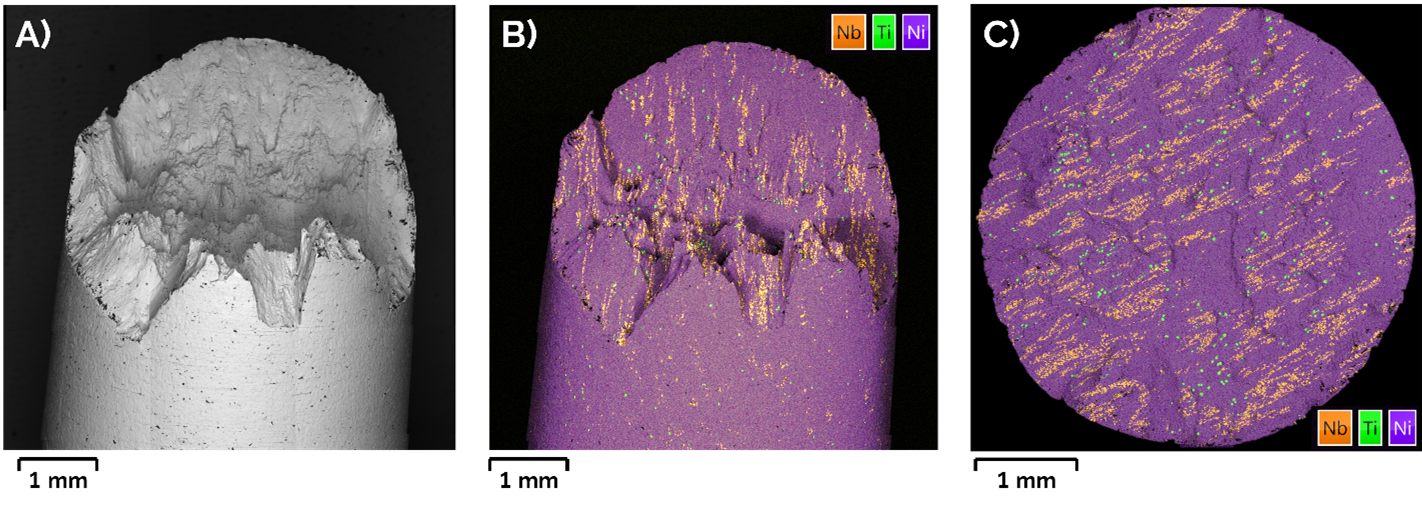
Figure 1: Montaged BSE (A) and BEX (B) images acquired across the fracture surface at an oblique angle. (C) Montaged BEX image acquired across the fracture surface, orientation parallel with long axis of fastening.
BEX imaging revealed extensive development of niobium carbide stringers (Fig. 1) distributed continually throughout the tensile strength testing specimen (Fig. 2). Figure 2 reveals that the preferred orientation of the stringers strongly matches the fracture surface orientation. Note that that the simultaneously collected EDS data has comparatively low sensitivity, leading to less clear visualization of the stringers and displays clear shadowing (Fig. 2D).
While Nb carbide inclusions are expected in some Ni-alloys, stringer formation like exhibited in this sample is a detrimental artefact of the hot working processes, where inclusions become amalgamated and elongated. This artefact reduces the strength of the Ni-Alloy, likely leading to its premature brittle failure.
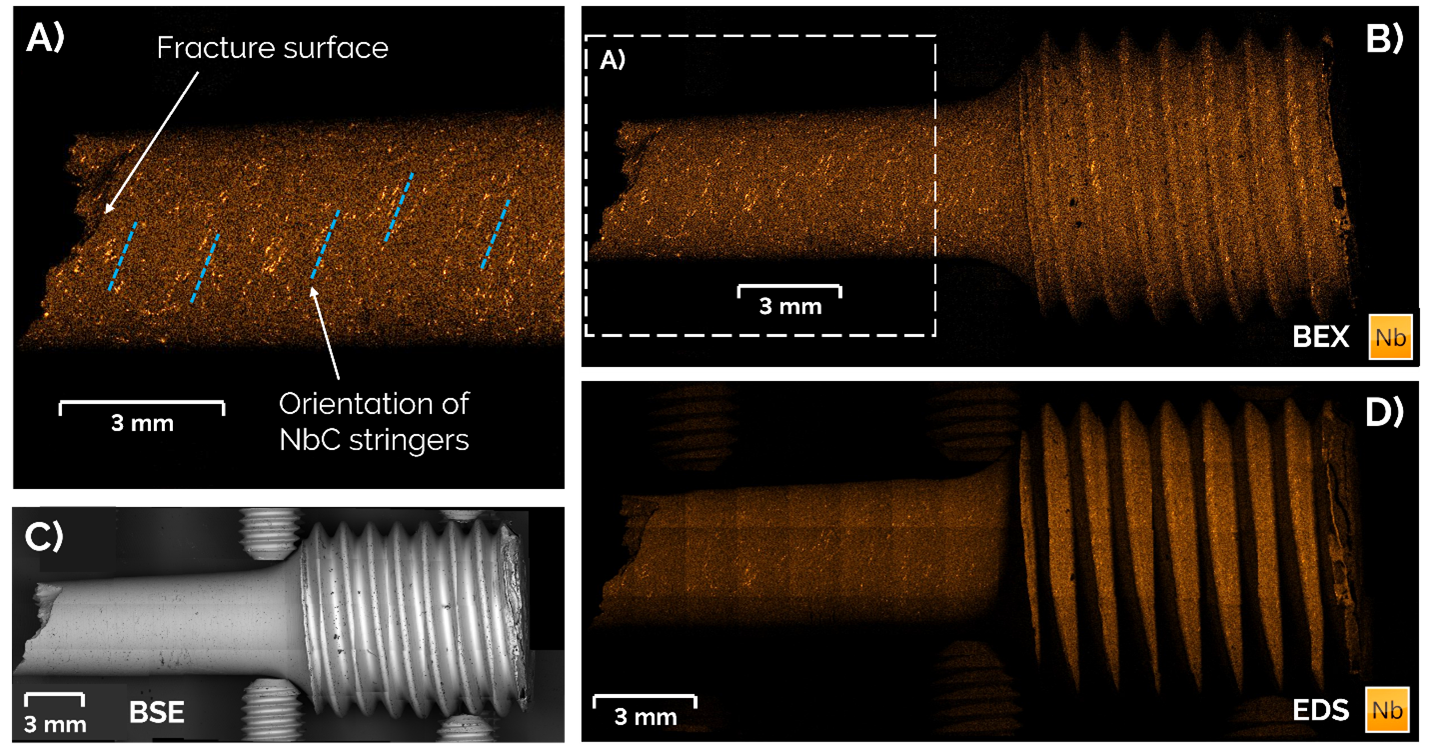 Figure 2: Large area BEX X-ray (A, B), EDS (D) and BEX BSE montage (C) acquired across the failed testing sample. The sample has been analysed perpendicular to the fracture surface, clearly displaying the preferred orientation of NbC inclusions parallel to the trend of the fracture surface.
Conclusion: SEM-BEX Enables Fast, Conclusive Insight into Tensile Testing
This case study demonstrates the power of SEM-BEX for rapid analysis of unconventional specimens, providing clear insights on the failure root cause. Specifically, the use of BEX means that:
- No sample preparation was required
- Fast, high-quality BSE and X-ray mapping was acquired, even on rough surfaces with long working distance
- Clear, unambiguous identification of reasons for failure were determined
The study clearly shows that enhancing your SEM with BEX unlocks the ability to collect high-quality, actionable data with ease, even on the most challenging samples.